

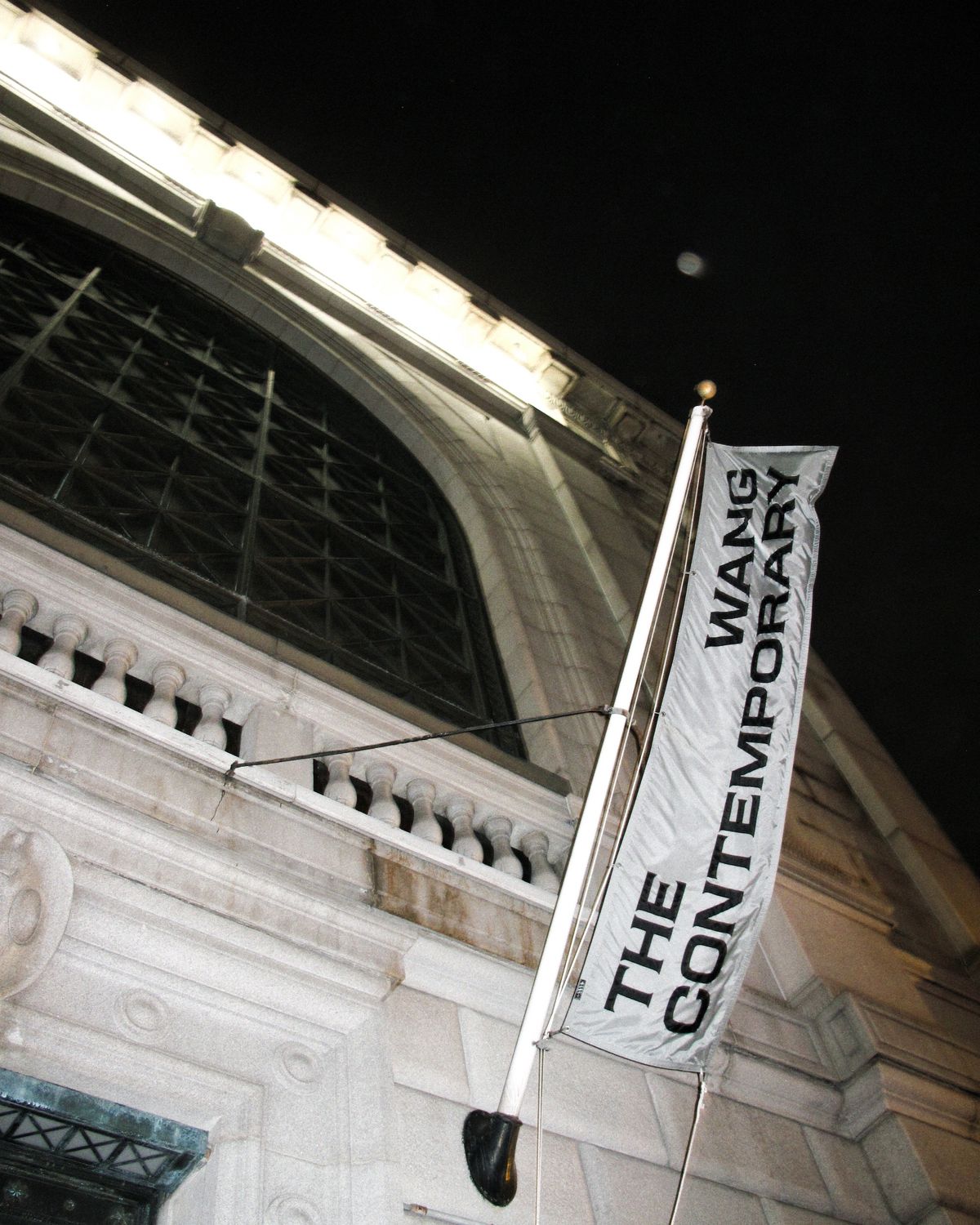
On 20 February, the Wang Contemporary made its public debut at 58 Bowery, a century-old bronze-domed Beaux Arts landmark at the edge of Manhattan’s Chinatown. Founded by the fashion designer Alexander Wang and his mother, the businesswoman and philanthropist Ying Wang, the cultural organisation opens with a vision ten years in the making: to serve as a global platform for Asian and Asian American creativity, bridging the historic neighbourhood it calls home with audiences and artists from across the world.
To inaugurate the space, the Wang Contemporary commissioned 20,000 Variations On A Paper Plane In Flight from MSCHF, the Brooklyn-based conceptual collective known for elaborate, subversive interventions that poke fun at financial, political and cultural systems. Timed to coincide with Lunar New Year, the three-day installation unfolded hourly across the building's seven-storey atrium. Accompanied by Thousand Ripples, a perpetually evolving soundscape composed and performed by the Seoul-born pianist Yeonjoon Yoon, at precisely 37 minutes past the hour, a flock of red and gold paper planes was launched from the building’s central oculus, darting and floating through the air before coming to rest on the ground below, where visitors were invited to collect them.
The planes were designed to resemble hongbao, the red envelopes containing money traditionally exchanged during Chinese New Year to symbolise good luck and prosperity—an especially appropriate allusion inside a former bank. When unfolded, each envelope revealed a single word drawn from 5,000 of the most commonly used nouns in the English language.
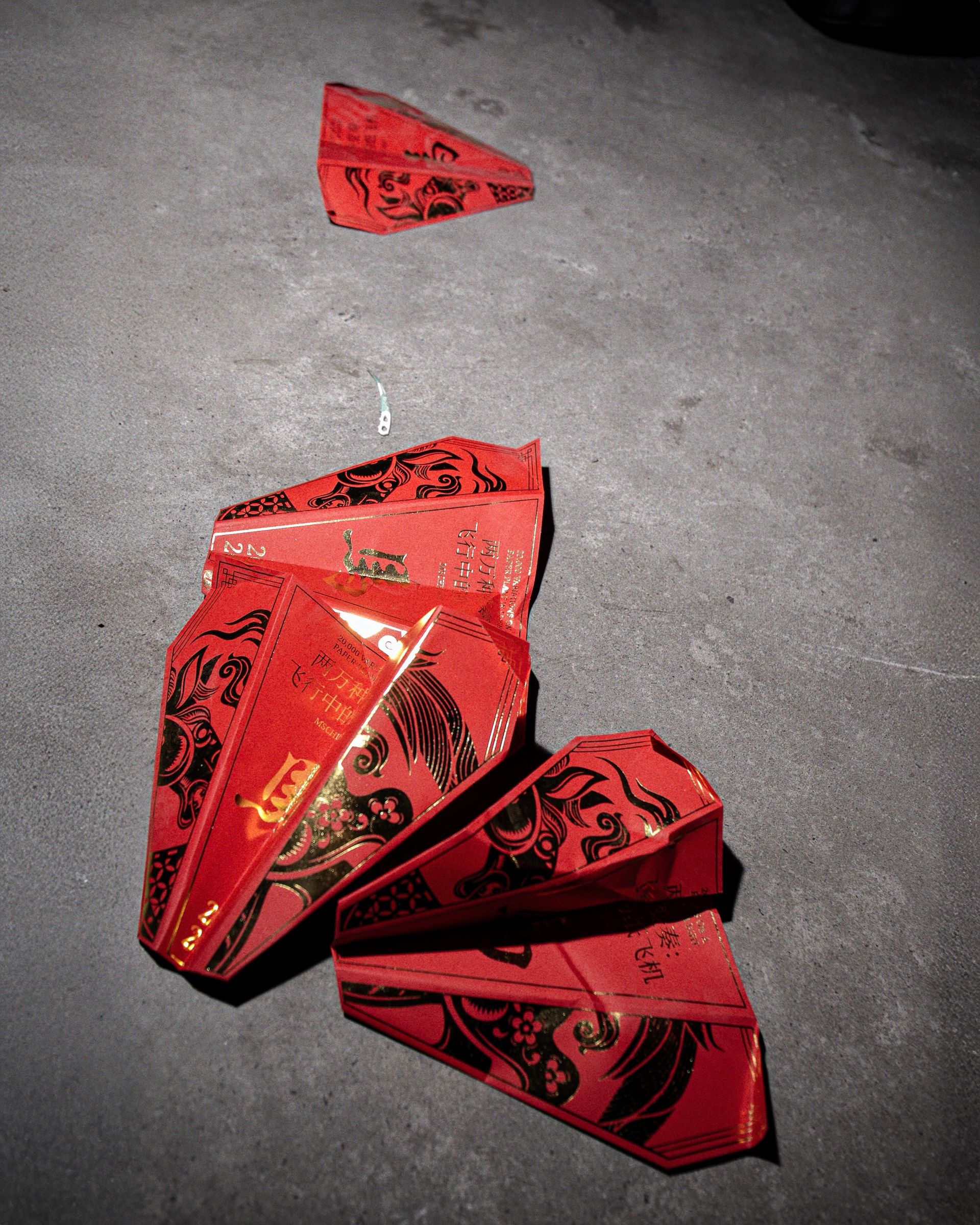
Detail of the paper planes used in MSCHF's 20,000 Variations On A Paper Plane In Flight, the inaugural commission at the Wang Contemporary Courtesy the Wang Contemporary
The commission reportedly reflects a deliberate shift in MSCHF's practice, as the collective moves away from internet-native provocations and toward slower, more embodied work. 20,000 Variations resists social media documentation and rewards the experience of simply being present in the room. “Their idea for the installation was exactly what we want the Wang Contemporary to be,” Alexander Wang says, “a space that pulls you in and surprises you once you’re inside.”
The space’s inaugural commission was conceived in response to the building itself, a vaulted space ideally suited for spectacle. “As the 20,000 planes concept came together, we felt it wanting to become increasingly atmospheric,” the members of MSCHF tell The Art Newspaper. “The building is an incredibly unique site for intervention in part because of how its history shapes its architecture.”
Situated directly opposite the Manhattan Bridge’s northern end at the corner of Canal Street, 58 Bowery has been a Chinatown landmark for a century. Originally constructed in 1924 as the Citizens Savings Bank headquarters and designated a New York City landmark in 2011, it is known for its Beaux Arts facade, vaulted interior and bronze dome. The Wangs had their eye on the property for nearly seven years before acquiring it in 2025 for a reported $9.5m—the first time in its history that the building has come under Chinese American ownership.
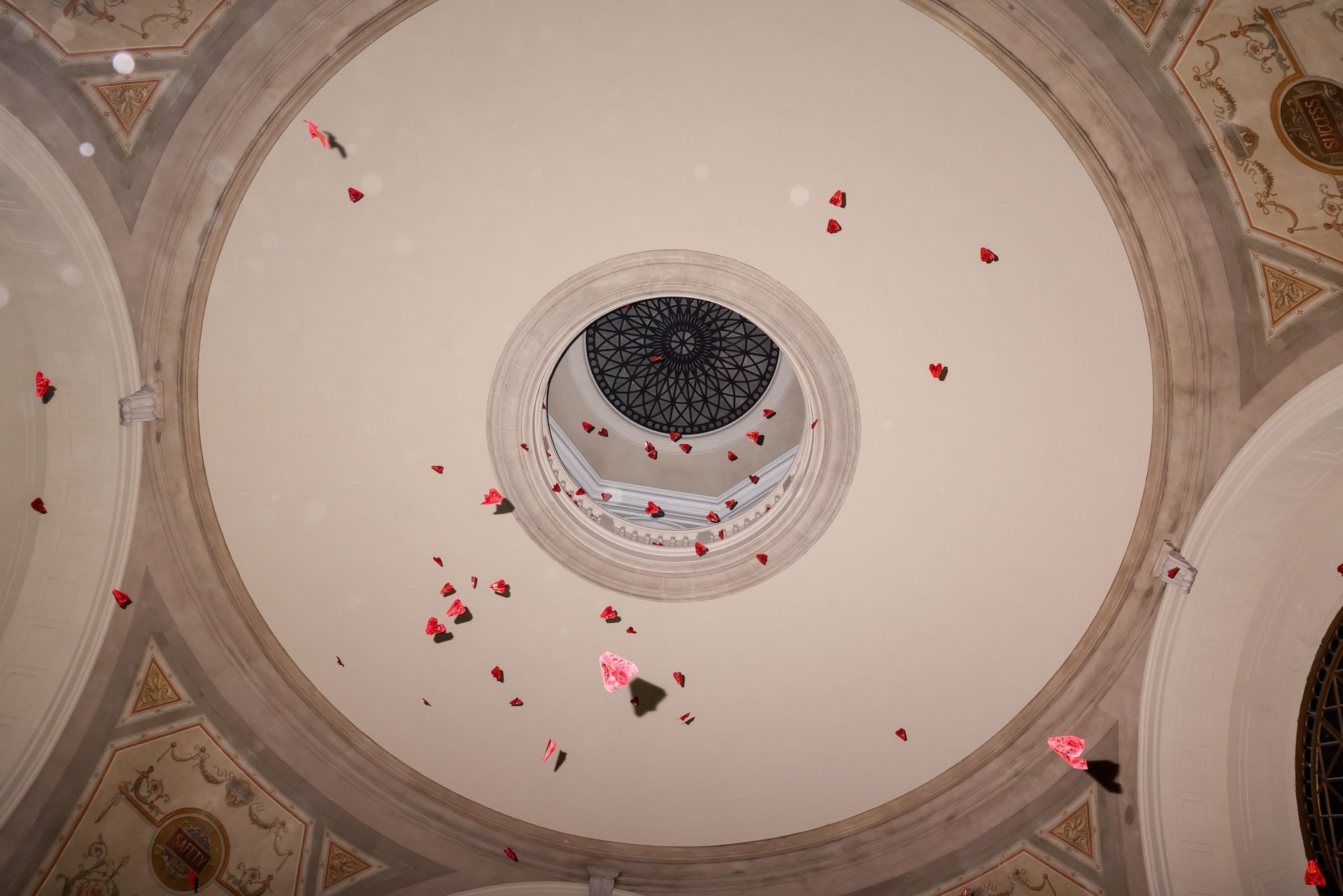
The release of the paper planes in MSCHF's 20,000 Variations On A Paper Plane In Flight, the inaugural commission at the Wang Contemporary Photo by Yvonne Tnt / BFA Selects, edited by Peter Zwolinski
“It feels significant for a historic bank to become an Asian American-owned cultural space,” Wang tells The Art Newspaper, “not just for us but for the neighbourhood.”
In restoring the building, the Wangs were guided by a desire to honour history while looking toward the future. “We wanted to be faithful to the building’s original architectural grandeur while opening it up to feel alive and accessible,” Wang says. Inside, the four original bank murals—Safety, Success, Thrift and Wisdom—remain, repurposed as a statement of institutional values.
“Wisdom speaks to the intergenerational exchange we want to foster,” Wang says. “Safety is about creating a space where artists can take risks without fear. Thrift represents our commitment to doing more with what we have, and to making access one of our priorities. And success—we want to measure that by impact, not scale."
Both he and his mother describe the organisation as the culmination of a long-term vision cultivated from lived experience. For Ying Wang, it grew from a lifetime of navigating between cultures; for Alexander Wang, from growing up rarely encountering institutions that reflected his cultural identity.
“We’re at an inflection point where the eastern perspective is being celebrated more globally in ways that feel new,” Alexander Wang says. “There’s more visibility than there was five years ago, but it’s still not quite there yet. We wanted to create something that speaks to this and can continue to build upon it. The urgency is both about seizing the moment and about ensuring something permanent exists on the other side of it.”
Met with palpable joy and anticipation among attendees of the celebratory inaugural programme, the institution’s launch has not come without some scrutiny. In 2020, Alexander Wang was accused of sexual assault by multiple men, prompting public debate and impacting his standing in the fashion industry. Wang posted a public acknowledgement of the accusations and has consistently denied the allegations; a lawsuit brought on behalf of 11 people who had accused Wang of misconduct was settled.
After stepping back for some time, Wang returned to the runway in 2022 with a presentation in Los Angeles, and has since rebuilt his profile, most notably in China, where his brand has retained considerable influence. The Wang Contemporary represents his most public reemergence in New York and, for some, will inevitably colour the reception of an institution that positions itself as a safe and inclusive space for artists and communities.
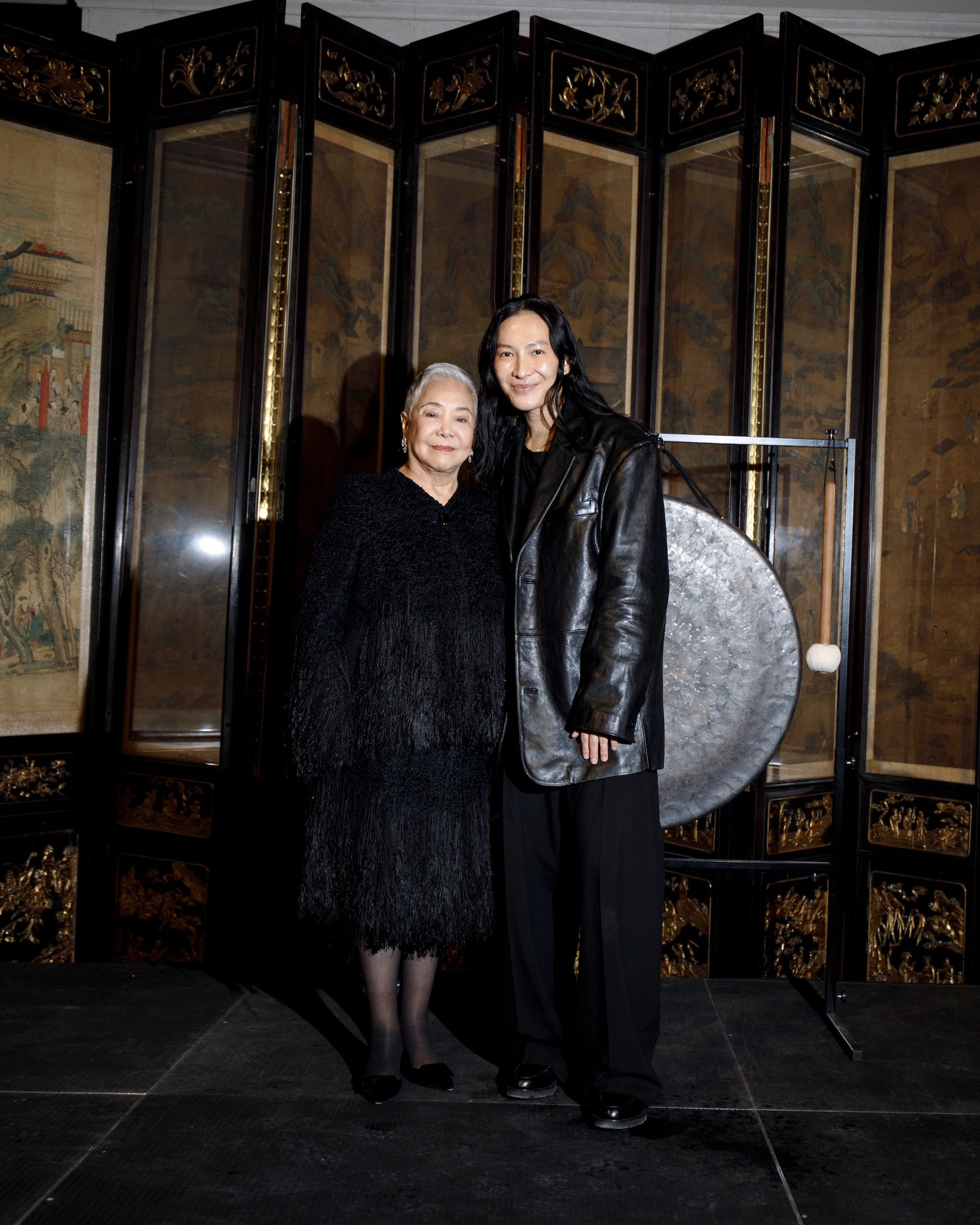
Ying and Alexander Yang at the grand opening of the Yang Contemporary Courtesy of the Wang Contemporary
The Wang Contemporary’s institutional mission to champion Asian artists comes as the surrounding neighbourhood is being reshaped by gentrification. Residents, artists and businesses in Manhattan’s Chinatown have long contended with the forces real-estate development, and the arrival of a well-resourced, internationally ambitious institution inevitably raises questions about whose interests it serves. The Wangs' answer is to reframe the premise: rather than treating global ambition and community investment as competing priorities, they see one as the engine of the other. A destination that draws the world to Chinatown, they argue, is itself an act of revitalisation that stands in contrast to the commercial development that has long threatened the neighbourhood’s character.
“The building could have been acquired by a commercial entity with no investment in the neighbourhood,” Wang says. “That’s a story Chinatown knows well. The Wang Contemporary prioritises community relationships as a core obligation, not a secondary thought—that means accessible programming when possible, working with local partners and staying in dialogue with the residents around us.”
Looking ahead, the organisation plans to mount exhibitions, performances and festivals drawing on established and emerging artists from across Asia and the global Asian diaspora. A martial arts festival is planned for Asian American and Pacific Islander Heritage Month in May.