


Minneapolis is moving closer to a permanent memorial for George Perry Floyd with the launch of a new student design competition. Organised by Rise & Remember, a group formed in the wake of Floyd’s murder by police on 25 May 2020, in partnership with Floyd’s family and the city of Minneapolis, the project grew out of research conducted by architecture students at the University of Minnesota.
Students from across Minnesota are invited to submit designs for a permanent memorial at a 2,247 sq. ft site outside the Cup Foods at East 38th Street and Chicago Avenue, where Floyd died in May 2020 after former officer Derek Chauvin knelt on his neck. The intersection has since been renamed George Perry Floyd Square and features a traffic circle with a temporary memorial at its centre, as well as other tributes and murals nearby.
The design competition opened on 2 March and closes on 19 May. The contest will award cash prizes to the top ten student designs, with $1,500 going to the winner. The top three students will advance to a second phase: a global competition open to designers, architects and public artists of any age. A panel of family members, community stakeholders and public art and design experts will select the final design before it moves into a city approval process.
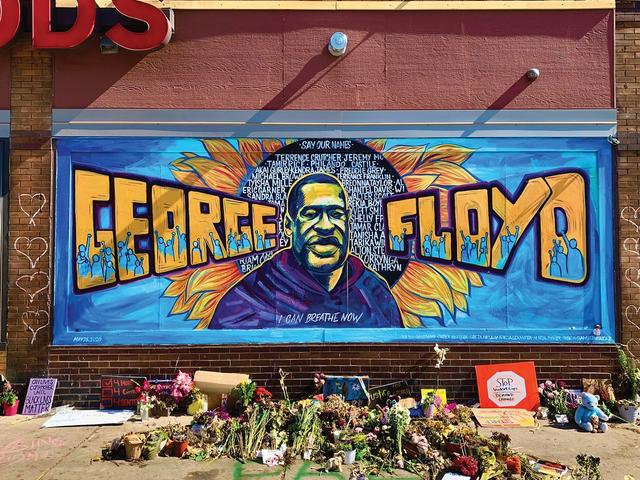
The initiative builds on work led by professor Anjali Ganapathy, now the director of undergraduate studies at the University of Minnesota. In 2020 she was teaching at Dunwoody, a technical college. When students reached out to her after Floyd’s murder, “we all got together, and they were very upset, obviously, by the turn of events”, she says. “As designers and architects, there is a space for us to express ourselves in a way that many people don’t. How do you express this spatially at the square?”
Working with the National Organization of Minority Architects, Ganapathy organised students from area colleges and universities with professionals who mentored them as they explored how to memorialise Floyd’s life. The effort culminated in an online exhibition. Those early conversations laid the groundwork for a permanent memorial process.
“It’s definitely a memorial to the man himself,” Ganapathy says. “It also signifies the larger movement that sprung up after his death, not just locally, but globally.”
Niall-Julian Universe, the administrative coordinator for Rise & Remember, says the organisation grew close with Floyd’s family while maintaining the temporary memorial at the intersection. “It’s all in the name of conserving these stories of resistance and people working together,” he says.
Angela Harrelson, the co-chair of Rise & Remember and Floyd’s maternal aunt, says she hopes the design contest will re-activate the spirit that ignited in 2020 following her nephew’s death. “This is something that we feel like the world needs now to show, hey, we’re still here,” she says.
According to Harrelson, Floyd’s family members all have had different processes of grief over the last six years, but they are now united in a desire for a memorial. “We want a memorial that speaks to all the people that held us up in solidarity,” she says.
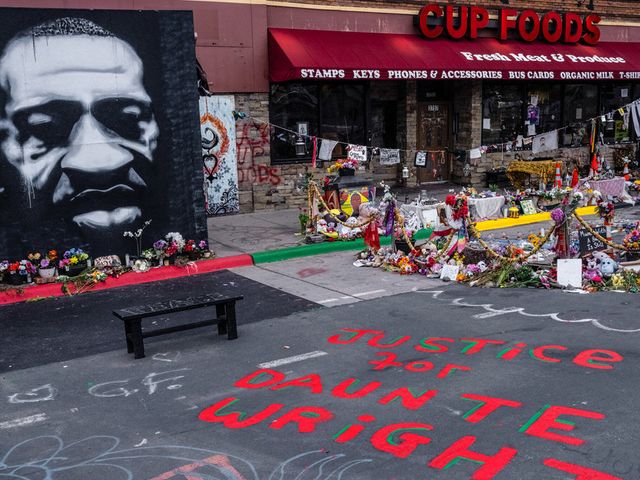
Mary Altman, Minneapolis’s public art supervisor, says the city has approved a new road layout for the intersection, but the memorial, because it sits within a public street, will likely require an encroachment permit or potentially a more formal agreement with the city.
The city will break ground on a road construction project on Chicago Avenue this year, a project that will afford an opportunity to prepare the memorial site with footings or utilities in advance, Altman adds. Ultimately, she framed the city’s involvement as fulfilling a promise.
“It’s very important that George Floyd and the impact of this murder be honoured at this location,” Altman says. “The mayor and the city have said all along that we would preserve a space for the memorial.”