


The British artist Rose Wylie is known for her giant, exuberant figurative paintings that combine an eclectic and idiosyncratic range of references taken from across art history, ancient civilisations, cinema, television, celebrity culture, current affairs and her direct surroundings. She studied at the Dover School of Art and Goldsmiths’ College in the 1950s but stopped making art for 25 years to raise a family—although she continued to teach throughout this time. In 1979, as a mature student, Wylie studied for a postgraduate degree at the Royal College of Art (RCA) in London, graduating at the age of 46.
But it was not until the 2000s that her work achieved wider recognition, most notably when she was included in Women to Watch at the National Museum of Women in the Arts in Washington, DC, in 2010. This was the same year that Germaine Greer wrote about Wylie in The Guardian under a headline calling her “Britain’s hottest new artist”. Institutional UK solo shows soon followed in the 2010s at the Jerwood Gallery, Tate Britain and the Serpentine Gallery. Wylie also won the John Moores Painting Prize in 2014 and was awarded an OBE in 2018.
Now, at 91, she is the first woman painter, and only the second female artist, to occupy the main galleries at the Royal Academy of Arts (RA) in London with her largest career survey to date. The show comprises more than 90 works, including a number of new paintings made over the past two years.
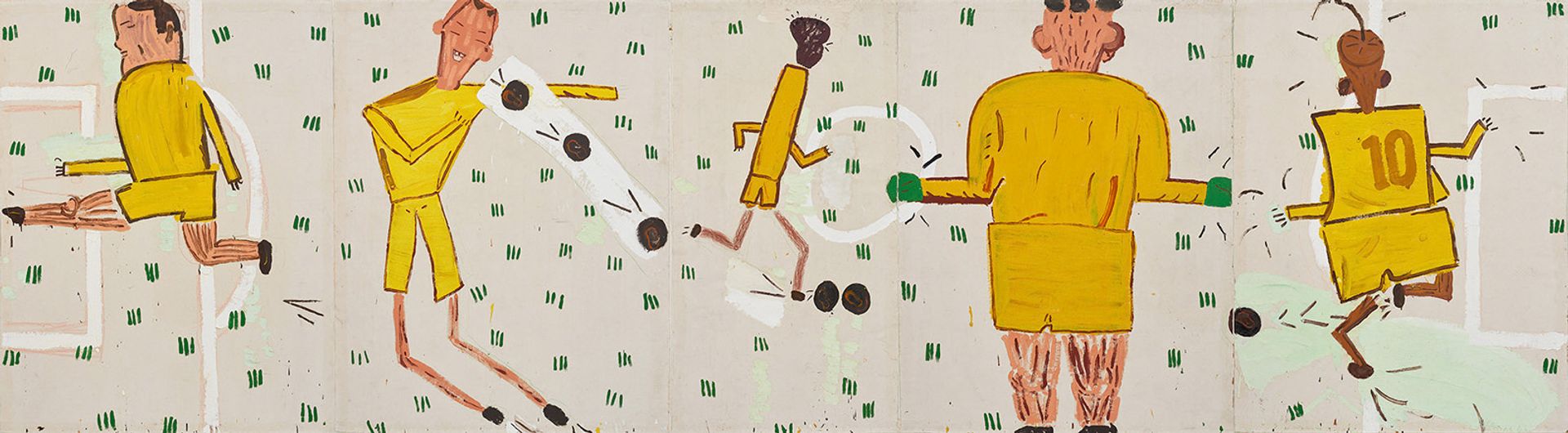
Yellow Strip (2006) is one of more than 90 works Wylie has brought to her Royal Academy show
Photo: Jack Hems, courtesy the artist and David Zwirner, © Rose Wylie
The Art Newspaper: Can you elaborate on your choice of title for the RA show, The Picture Comes First? Why do you say “picture” rather than “painting”?
Rose Wylie: I like the word “picture”. It goes more with childhood. Pictures are in books. Pictures are things you look at; you don’t read them. It’s a great word, it’s not arty. Ontologically, the important thing is the painting, and as soon as you interpret it, you’re moving away from it. If people refer to something outside the picture or painting, then it diminishes it. The painting isn’t illustrating an idea—the painting is the thing. It’s the picture, the image.
So, you want your paintings to occupy their own reality as distinct from what we might project onto them.
It’s metaphysical. I have no problem with the word. Some people do. I love it. But the paintings are also very physical. So, it’s quite funny because I go on all about metaphysicality but the paintings themselves have a lot of materiality, which is a confliction. I think we’re all conflicted all the time. I know I am.
Another conflict—or paradox—in your paintings is the way in which their spirit of freedom and spontaneity is in fact hard won and carefully considered.
It certainly is. There’s a lot of discernment that goes on and a lot of decision-making. The whole aesthetic build-up for your age—and the older you are, the more the build-up—it’s all in the painting, in every move. Shall I change the face? What shall I do? It’s very, very fragile where a painting ends. All the time it sits on a precarious edge. Because it could just change. This painting we are looking at here, I could paint the face out tomorrow. I probably won’t, but I could.
You are not averse to leaving in corrections and crossings-out.
I love crossings-out. I love the first decision being left. It’s the opposite of the computer: you can’t do crossings out on a computer—or at least I can’t. But in a painting or drawing, you can do it as much as you want, so let’s do it. The world generally thinks you shouldn’t cross out: let’s not have a mess, tidy it up. But it’s not a mess. It shows an earlier choice that has been dismissed.
Then there is your grappling with the quality of the paint itself and what it can be made to say and do.
It’s so varied. Sometimes it’s smooth like icing, sometimes its lumpy (I don’t mind if it has lumps), sometimes it drips, sometimes it’s runny. You get physical edges in the paint. It isn’t just a representation, it’s not just an appearance; it’s nearly sculptural. A piece of wet paint can run into another piece and you can leave it or not. If it’s slimy and unpleasant you take it off, if it’s really rather nice you can leave it. People don’t notice all that; they say it’s careless, but it isn’t. My paint is expensive, it’s what [Frank] Auerbach and [Leon] Kossoff used, and my canvas is heavy, good-quality, 15-ounce canvas but I don’t bend it around the stretcher. I’m a bit careless of my brushes but that means I’ve got to be extremely skilful to get the brush to do what I want, because the brush isn’t refined. You can’t keep on doing the same thing; it’s just boring.

Kill Bill (Film Notes) (2007) reflects Wylie’s diverse range of cultural references, from ancient civilisation to cinema. “I paint celebrities because people know what they look like, so they can see what I’ve done,” she says
Photo: Soon-Hak Kwon, courtesy private collection and Jarilager Gallery, photo courtesy Jarilager, © Rose Wylie
At the RCA, the subject of your MA dissertation was the language of drawing and how it is taught in English art schools. Now, at the RA, there is an entire room devoted to your drawings and works on paper. Does every painting begin with drawings?
Yes. Drawing is everything. Drawing comes first. I’ve got tons of drawings; I draw all the time. I may have eight drawings, and the painting comes from one of these. Or it may change and go from another drawing. Drawings are hugely important because they’re the beginning. Starting with a bare canvas where you’re just yourself, that’s a problem. It becomes too much the author, too much repetition. You get stuck on doing the same, same, same. But if you’ve got a drawing of something you’ve seen, it breaks that. It allows the painting to be partly you, but also partly the drawing and partly the fact that you had to choose that drawing [and] also partly the paint you’re using and the time you’re working in. It brings together several factors. It’s not just me making a painting, it’s me with a percentage of the subject, whatever it is, and a percentage of the drawing of the subject.
You also often incorporate text into your paintings.
I like the combination of text and image: sometimes the text is huge and meandering, sometimes its spelt wrong. I love Medieval manuscript paintings, Mexican retablos, the newspaper. But I still think the image comes first; I have more respect for the image.
You’ve used the term “poetic transformation” in relation to what you want to achieve in your paintings. Can you describe this?
The process starts with the drawing, and then it goes on. You want it to be a new description of something you know about, to move from reality to poetic reality. That’s why I paint celebrities because people know what they look like, so they can see what I’ve done. I don’t want too much realism, because I want poetic transformation. But sometimes it transforms too much. If it goes too far, then what’s the point of doing the drawing in the first place? The drawing is the product of visual excitement, of being excited about something I’ve seen. And I hope that this visual excitement will remain through the stages of poetic transformation.
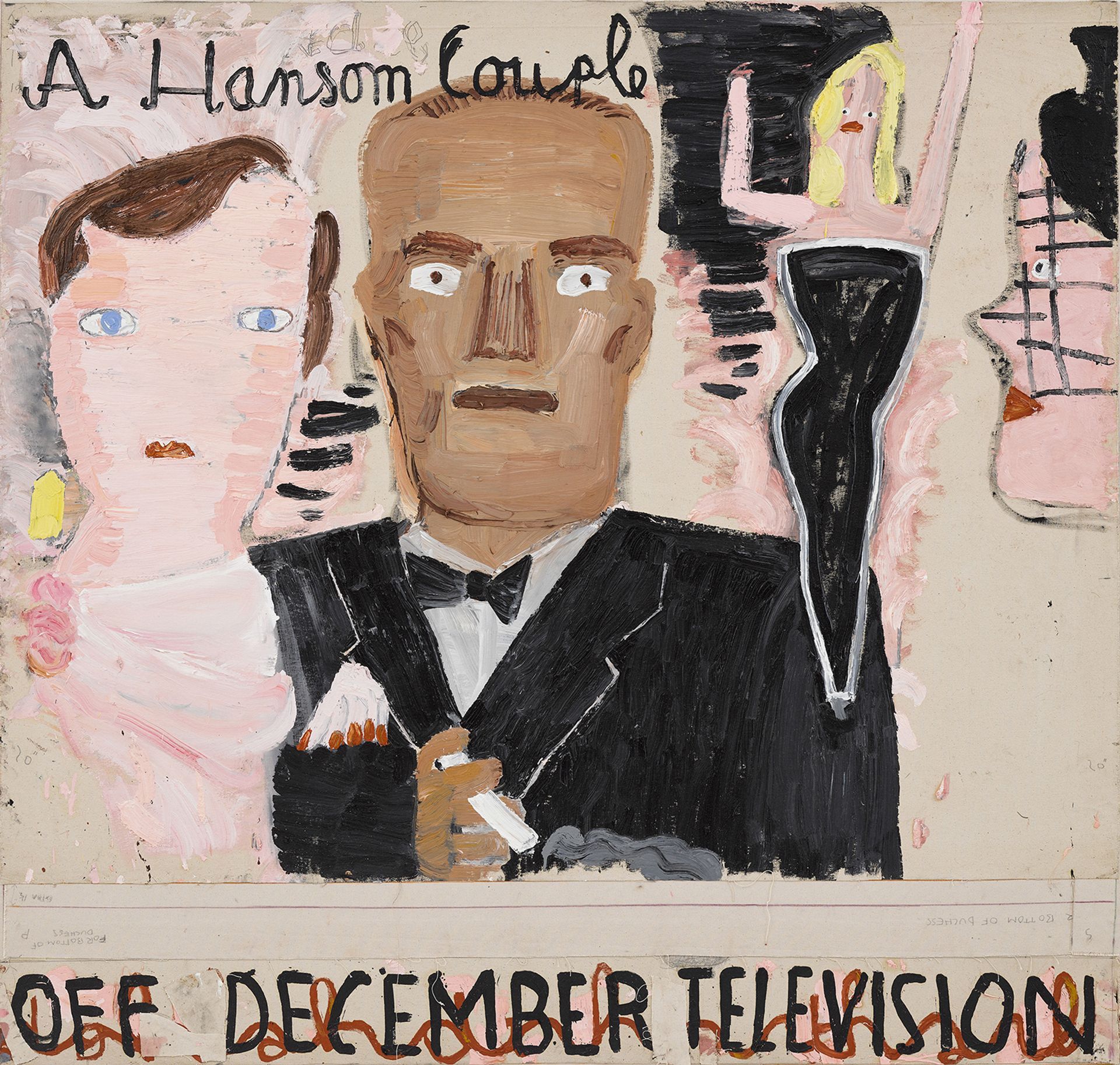
Wylie’s A Handsome Couple (2022) was inspired by a photograph of the scandal-prone Duchess of Argyll
Photo: Jack Hems, courtesy Edwin Oostmeijer, © Rose Wylie, courtesy the artist and David Zwirner
This visual excitement can be triggered by a multiplicity of things: a detail from art history or an ancient artefact, a personal memory, or what you see around you, whether a flower outside your window, a photograph in a newspaper, sport on the television or a scene from a movie. Then, often, images from across these different sources can come together in a single painting.
Me, my own environment, plus film and art history—I think those are the big things. But people often leave out that it’s the world around me and that it’s particular; I’m not into generalisations. Some things do come from memory, and memory is important because it sifts the conditions of what you are looking at and gives emphasis to a particular that excited you at the time. But it’s memory informed by a lot of hard looking. And I don’t only do memory; I’m good at looking.
Scale is also important. Soon after you had finished at the RCA and had started making art again, you were working on a grand scale.
I like big paintings. I think it suggests confidence. That’s why I like cinema. I remember going to Tate Britain and seeing Steve McQueen’s film about Buster Keaton [Deadpan, 1997], and then I came out into the gallery and there were these little paintings and I thought, film just has it! I think it was a combination of that and early Renaissance paintings, which covered all the walls and went right round doors. I love coverage. I don’t like confinement. I like expansion. I like generosity. I don’t like restriction. I don’t like being too precious. It’s like being in a coffin. It’s like being in a hospital. I like being out in the middle of the road, with the traffic, the life. So I started doing big. I just put the canvas on the floor so I wasn’t caught up with just having a small space, and I didn’t stretch it, then I could add bits to make the paintings even bigger.
Now you are filling up the main galleries of the Royal Academy, the first woman painter to do so—and at an age when most people would be putting their feet up and cashing in their pensions. What impact do you want your work to have on a new audience, which extends beyond the contemporary art world?
I don’t feel like an old person—the word “pensioner” gives me the shudders. I like the Royal Academy, I like the building and I love that it’s off a main road and not secluded. And that it has a huge following. I want people to be affected. I hesitate to use the word “poignant”, because that often means sad and my paintings aren’t sad. But I think that poignant means that you are affected by something, and I would like them to think that there is something here which is exhilarating and has quality and is a point of life.
• Rose Wylie: The Picture Comes First, Royal Academy of Arts, London, 28 February-19 April
Biography
Born: 1934 Hythe, Kent
Lives and works: Newnham, Kent
Education: 1952-56 Dover School of Art; 1956-57 Goldsmiths’ College, London; 1979-81 Royal College of Art, London
Key Shows: 2012 Jerwood Gallery, Hastings; 2013 Tate Britain, London; 2016 Turner Contemporary, Margate; 2017 Serpentine North, London; 2020 Aspen Museum, Colorado; 2020 Hangaram Art Museum, Seoul; 2022 S.M.A.K., Ghent
Represented by: David Zwirner