

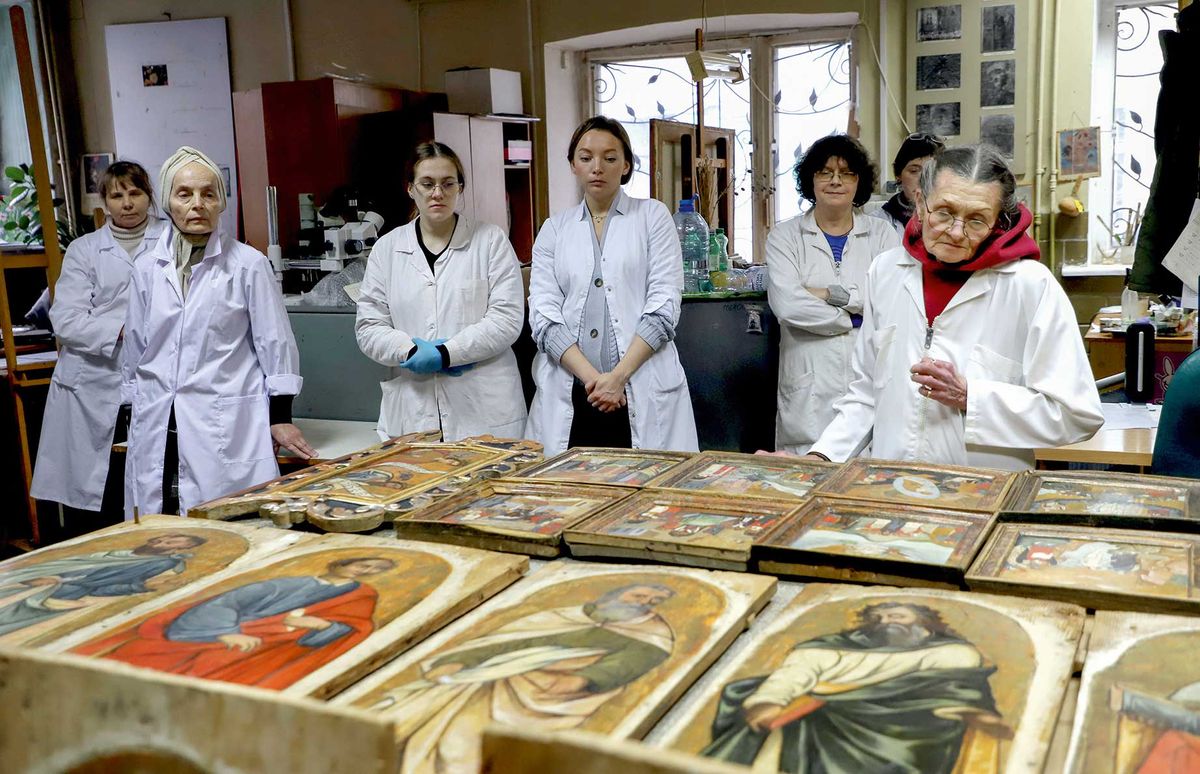
During the four years since Russia’s full-scale invasion, Ukraine’s cultural heritage has been under constant assault. Peace still seems out of reach. While the bulk of international funding is focused on immediate humanitarian needs and weapons for Ukraine, the country’s culture ministry and an array of national and international heritage organisations are doing what they can to rebuild even as the war rages on.
A new initiative, the Ukraine Cultural Heritage Fund, started to take shape last year. This project will add to programmes by organisations including Unesco; Aliph; the World Monuments Fund; ICCROM, a Rome-based intergovernmental organisation; and Obmin, registered in 2022 in Warsaw to aid Ukrainian museums via joint heritage protection projects.
“As of November, Russian aggression has resulted in the destruction or damage of 1,630 cultural heritage sites and 2,437 cultural infrastructure facilities across Ukraine,” the country’s culture ministry wrote in an emailed response to questions from The Art Newspaper. “These losses are the direct consequence of daily Russian attacks. Responding effectively requires the combined efforts of the international community.”
Announced at the fourth Ukraine Recovery Conference in Rome in July 2025, the Ukraine Cultural Heritage Fund is “conceived as a multidonor platform designed to mobilise international resources for the protection, restoration, and development of Ukraine’s cultural heritage and culture damaged by war,” the ministry says.
Denmark, the Netherlands and the United Kingdom are among the countries to pledge to contribute to the fund, committing DKK 10 million (£1.2m), €1 million and £200,000 respectively. The fund has identified 13 initial restoration projects including the Gothic rose window of St Nicholas Church in Kyiv, damaged by a Russian missile strike in 2023.
Unesco is working on a new rapid damage and needs assessment for the recovery of Ukraine’s culture. Its latest assessment, dating from December 2024, gave a figure of $4.1bn, $3bn of which is the cost of rebuilding historic cities, buildings and sites. So far, the Ukraine Cultural Heritage Fund has mobilised €3.5m, the Ukrainian Culture Ministry says—a tiny fraction of that amount.
Donors are cautious
“The war significantly increases donor caution, complicates risk assessment, and shifts global attention toward immediate humanitarian and security needs,” the ministry says. “For the international community today, prioritising security and support for Ukraine’s armed forces is both natural and self-evident. To protect culture, Russian aggression must be stopped and Russia must be deprived of its ability to wage war.”
Switzerland-based Aliph, one of the NGOs most active in Ukraine, has been charged with setting up the Ukraine Culture Heritage Fund in Brussels. Aliph has already spent $8m since 2022 on work ranging from the transportation of museum art to safe havens in western Ukraine to the digitisation of buildings and collections, stabilisation of damaged sites and support for professionals. The organisation’s system of emergency grants has sustained institutions dealing with a cascade of crises, from Russian missiles and drones strikes to the threat of illegal occupation by Russia, which has stolen significant museum collections after annexing parts of Ukraine’s Kherson and Donetsk regions.
“If you compare the situation in Ukraine today and in Gaza, and the one 15 years ago or the mausoleums in Timbuktu in 2012, there is a larger sense of the importance of cultural heritage today than 15 years ago,” says Valéry Freland, Aliph’s executive director.
The difficulties of reconstructing during war are particularly apparent in the region of Odesa, which has suffered around 8% of the total damage in Ukraine, according to Unesco. The port city’s multicultural history and strategic location on the Black Sea draws a constant barrage of Russian missiles; it is coveted by Putin, who regards it as Russia.
Oleksandra Kovalchuk, the deputy director for development at the Odesa National Fine Arts Museum, says the building was stabilised with Aliph’s help following a 2023 missile strike, but it remains under constant threat because it is next to the port. Russia’s older Oniks missiles can be inaccurate, she says, putting the museum at risk when the port is targeted. Speaking to The Art Newspaper just after leaving Odesa for Bucharest, Kovalchuk said non-stop air raids in December left her so exhausted she fell asleep during the attacks.
Unesco is funding the stabilisation and restoration of the Transfiguration Cathedral in Odesa, which was severely damaged by a missile strike in 2023. Funding was contributed by Italy, which has also committed €32.5m for other sites in the region damaged by Russian attacks, including the Odesa National Fine Arts Museum and the Odesa Philharmonic. Italy is also contributing to the establishment of the Odesa Unesco Heritage Management Centre.
Unesco said in response to emailed questions that there are “understandable concerns about investing in reconstruction when sites could be damaged again if hostilities continue. That said the longer a conflict persists, the more needs accumulate and the higher the overall costs of recovery become.”
And while Ukraine continues to focus its resources on the war, the government has nonetheless found 16.145 billion hryvnias ($380m) for culture in the 2026 national budget, an increase of nearly 50% from 2025.
The war, the culture ministry said, “has made one thing unmistakably clear: culture is an integral component of national security. Cultural heritage is not only about buildings or collections—it is about identity, memory, values, and the resilience of a democratic society.”