

A new law empowering Turkey’s central government to seize historic properties from local authorities is raising fears that heritage sites are becoming the latest front in a wider campaign against opposition-led municipalities.
Among the sites at stake are cultural venues run by the Istanbul municipality, whose mayor Ekrem İmamoğlu launched an ambitious conservation drive and expanded cultural programming before he was jailed last year after announcing plans to run for president.
Changes to a law governing foundations, or vakıfs, took effect in December, stipulating that property originally endowed to a foundation—often centuries ago—or that once benefited from foundation resources, and is now held by other public institutions, will be transferred to state-run foundations.
Zeynep Oduncu Kutevi, a lawmaker for the People’s Equality and Democracy Party, warns that such legislation risks “not only cultural loss but a usurpation of the people’s will and identity” as the government seeks to “side-line” municipalities. Opposition parties won control of more cities than the ruling party in 2024 elections.
“This change directly contradicts the principle of local self-government,” Kutevi tells The Art Newspaper. “Properties that municipalities have restored, maintained and kept open to the public for years will be taken away.”
‘Safeguarding the legacy entrusted to us’
Tens of thousands of properties in Turkey were originally endowed to vakıfs to finance religious, educational or social services during the Ottoman era. Many are now managed by the General Directorate of Foundations in Ankara or other public bodies, including municipalities, after their original boards ceased to exist.
“Safeguarding the legacy entrusted to us by our nation and preserving the fabric of our cities while enabling development is our most fundamental priority,” Adem Çalkın, a lawmaker in the ruling Justice and Development Party who sponsored the bill, said on X before the law passed.
But the directorate’s mandate is to lease property, and it lacks the capacity, personnel and local knowledge to operate cultural spaces, says Ülkü İnanlı, the deputy chair of İmamoğlu’s Republican People’s Party in the Istanbul city council. “They will not operate these venues as the municipality has and either close or rent them out.”
While the changes affect assets nationwide, Turkey’s largest city of Istanbul hosts the greatest concentration of heritage sites. Since winning control of the city in 2019, İmamoğlu’s administration has repaired or restored nearly 1,000 historic properties, along with hundreds of monuments, fountains and graves.
İmamoğlu also sought to make Istanbul an international centre of contemporary culture, converting long-neglected spaces into museums, libraries and public venues. He credited his popularity ahead of his 2024 re-election in part to delivering greater access to culture, with the municipality allocating more than 1% of its roughly $10bn annual budget to cultural activities and conservation.
İnanlı believes the success of the policy is what led to the new legislation. “Once they realised cultural activities were a vote-getter, they decided to pass this law,” she says.
İmamoğlu’s arrest in March last year on corruption and terrorism charges, which he denies, triggered the largest anti-government protests in Turkey in more than a decade. More than 100 city officials were detained, including his deputy, Mahir Polat, an art historian who oversaw the restoration projects and was later placed under house arrest due to poor health.
A modern-day ‘Kulturkampf’
The battle over these sites is part of Turkey’s broader “Kulturkampf”, says Emre Erdoğan, a political scientist at Istanbul Bilgi University. “These sites provide income to the opposition, and that is a problem for the government,” he says. “If you want to silence the opposition, jailing people is one way, cutting off their resources is another.”
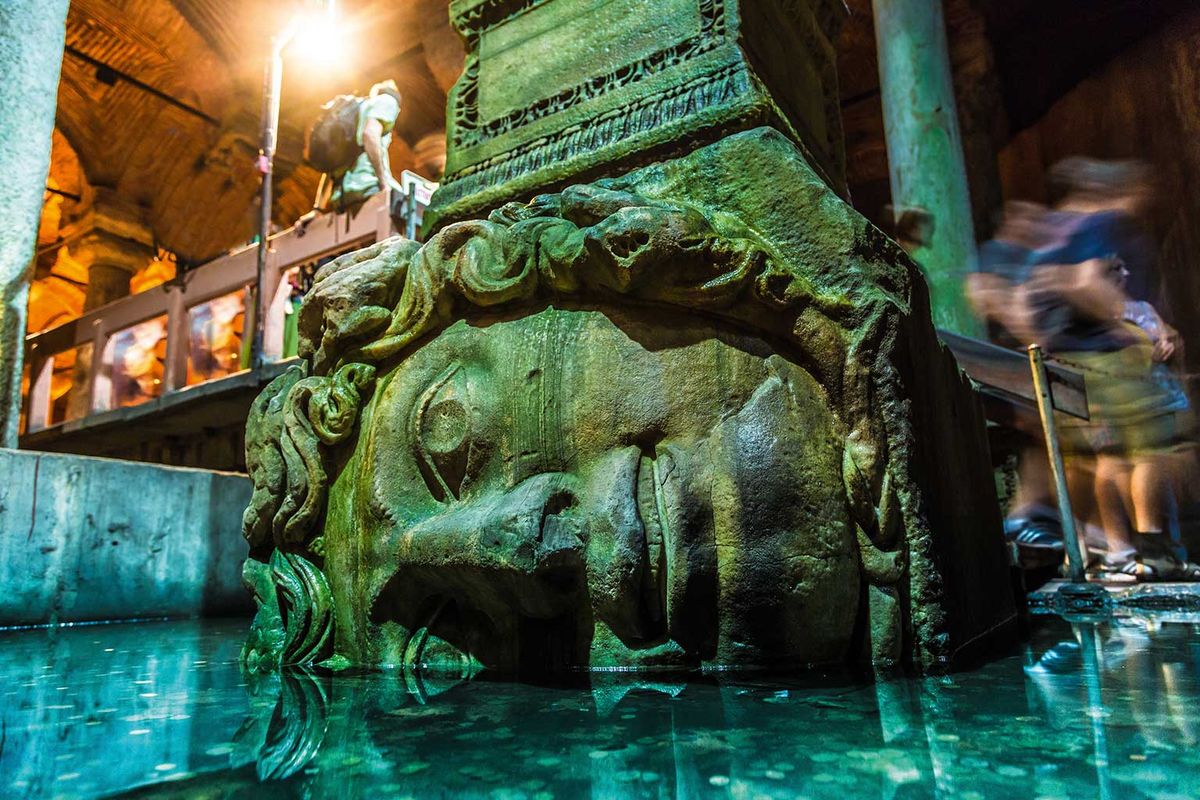
Among the sites that could be appropriated is the World Heritage-listed Basilica Cistern, built in the sixth century by the Byzantine emperor Justinian. Last year, nearly 2.8 million people visited the underground museum, which the city restored in 2022.
Also at risk are Casa Botter, Istanbul’s first Art Nouveau building, which reopened as a design centre in 2023, and ArtIstanbul Feshane, a 19th-century fez factory now used as a gallery that hosted a Tate Modern touring exhibition in 2024. “If the foundations directorate has made even a small repair to a structure in the past, this law permits them to take the property without bringing a lawsuit,” İnanlı says.
Kutevi worries the new rules will narrow public stewardship and public access if sites are converted into lucrative development projects. “These cultural assets will become a source of profiteering for the ruling party,” she says.
An example of the divergent approaches to heritage can be seen at Tersane, the 15th-century shipyard on the Golden Horn waterway. The state-owned portion of the waterfront opened as a privately run luxury hotel, shopping and residential complex in 2024. That same year, the city rehabilitated its smaller section into an art space and kept the docks working, sustaining the site as the world’s oldest continuously operating shipyard.