

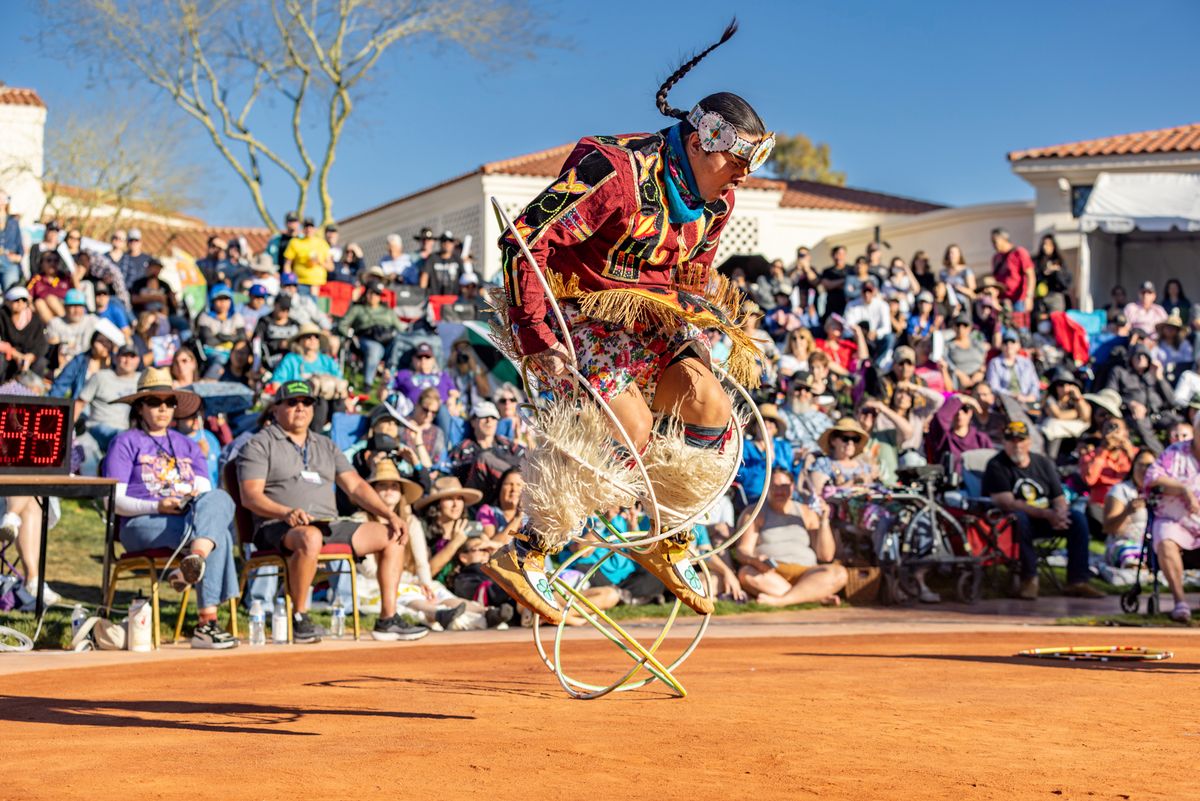
Last February, master of ceremonies Dennis Bowen (a Seneca elder) welcomed the reigning champion into the 2025 World Championship Hoop Dance Contest arena at the Heard Museum in Phoenix, Arizona. Thousands of spectators joined them to watch more than 100 dancers compete across the two-day event. Bowen announced Josiah Enriquez’s (Pueblo of Pojoaque, Navajo, Isleta) accomplishments as a top place finisher several years running in the teen division and as the surprise winner in an unprecedented tiebreaking round in the adult division the year before.
Enriquez, dressed in orange-and-white regalia, acknowledged the crowd with a broad smile, paid his respects to the judges and checked once more the position of the six hoops he had laid on the ground. In anticipation of the first beat of the drum, his smile faded and his focus sharpened.
As the music began, his feet tapped to the rhythm and soon, to the crowd’s delight, Enriquez’s entire body joined with moves that made his fur anklets shimmer and twirls that sent the orange fringe of his apron cutting through the air. In a near seamless movement the first hoop coiled up his body, over his head and landed spinning in his hand. Soon he was working all six hoops, creating stories of winged creatures, clasping jaws, galloping hoofs, impossible heights and seemingly magnetic hoop returns. At the end of the seven-minute dance, Enriquez dropped to one knee, overcome with emotion.
“It’s so important that our children are connected, or some of them introduced for the first time, to the culture, to the songs, to the drum group, the singers,” says Bowen, who was once a dancer and has emceed the competition for more than 30 years. “And we have people there ready to teach them.”
Hoop dancing is a tradition shared by many Indigenous communities and is associated with healing ceremonies. The hoop itself, often fashioned from willow, is symbolic of the unbroken circle of life and is regarded as sacred by many tribal leaders and holy men. Many will mark their hoops at four equal points, symbolic of seasonal changes, cardinal directions or sacred colours. There is a strong emphasis on tradition and how the hoop is manipulated, Bowen says; for instance, the hoop is not usually picked up, but first pivoted by foot.
“There would be different explanations by what Indigenous nation that hoop dancer comes from, and it would respect that that hoop is on Mother Earth,” he says. “There are different ways that a hoop dancer may say, ‘I was taught to respect the hoop, Mother Earth, and also respect me, myself’.”
Hoop dancing was modernised and reimagined by Tony White Cloud (Jemez Pueblo) in the 1930s when he created a travelling performance programme aimed at tourists that emphasised multiple hoop formations suggestive of globes and the natural world to share stories and traditional teachings. As he toured fairs and expositions across the country, White Cloud inspired a new generation of dancers.
From a handful to more than 100 competitors
It was not until 1991 that Bowen’s friends, the father-and-son duo of Ralph Zotigh (Kiowa) and Dennis W. Zotigh (Kiowa/Ohkay Owingeh) first conceived of a hoop dance competition at the New Mexico State Fair Indian Village. Bowen remembers at the time knowing only a handful of dancers. That first competition was deemed a resounding success, with 18 dancers competing.
“People were excited about it, and they said ‘keep it up’,” Bowen says. But the organisers needed a sponsor and a much larger venue. After considering locations in Minnesota and Connecticut, they agreed to a long-term partnership with the Heard Museum, an institution devoted to Indigenous art in downtown Phoenix.
The museum hosted the competition’s 36th edition over two days (14 February and 15 February), with more than 100 competitors from across four age groups (youth, teen, adult and senior). Contestants competed not only for titles but also for $25,000 in cash prizes based on criteria like showmanship, creativity and rhythm. Not to be forgotten are the musical groups, the Cozad Singers and Mandaree Singers, who performed around 120 songs throughout the competition. Organisers were expecting around 7,000 spectators. In the end, Enriquez repeated as winner in the adult division.
Women and girls now make up around half of the competitors, with men and women competing in the same categories rather than separated by gender. In 2000 Lisa Odjig (Odawa/Objiwe) became the first female adult champion.
The hoops are a place of learning. That circle is our classroom. It’s our universityDennis Bowen, hoop dance expert
Bowen emphasises the importance of the cultural and intergenerational ties formed at the event. Spectators and dancers, newly initiated and world champions alike, connect and share their questions and insights. This kinship is encouraged and appreciated by both sides.
“The hoops are a place of learning,” Bowen says. “That circle is a classroom. It’s our university.”