

There is more to the World Economic Forum (WEF) in Davos, Switzerland (until 23 January), than world politics and business affairs. “Within the forum’s mission, arts and culture play a vital role: they help ensure that progress is not defined solely by economic metrics or technological advances, but by our capacity to remain human, connected and reflective as we navigate an increasingly complex world,” says Joseph Fowler, WEF’s head of arts and culture.
His programme is anchored around three guiding pillars, “Human Presence in the Digital Age”, “Tradition and Innovation”, and “Connection and Collaboration”, Fowler adds. “Together they form a curatorial vision that pairs intellectual rigour with deeply immersive artistic experience.”
This year, participants include the Netherlands-based eco-artist Thijs Biersteker and the multimedia artist and technologist Ronen Tanchum along with the French street artist JR.
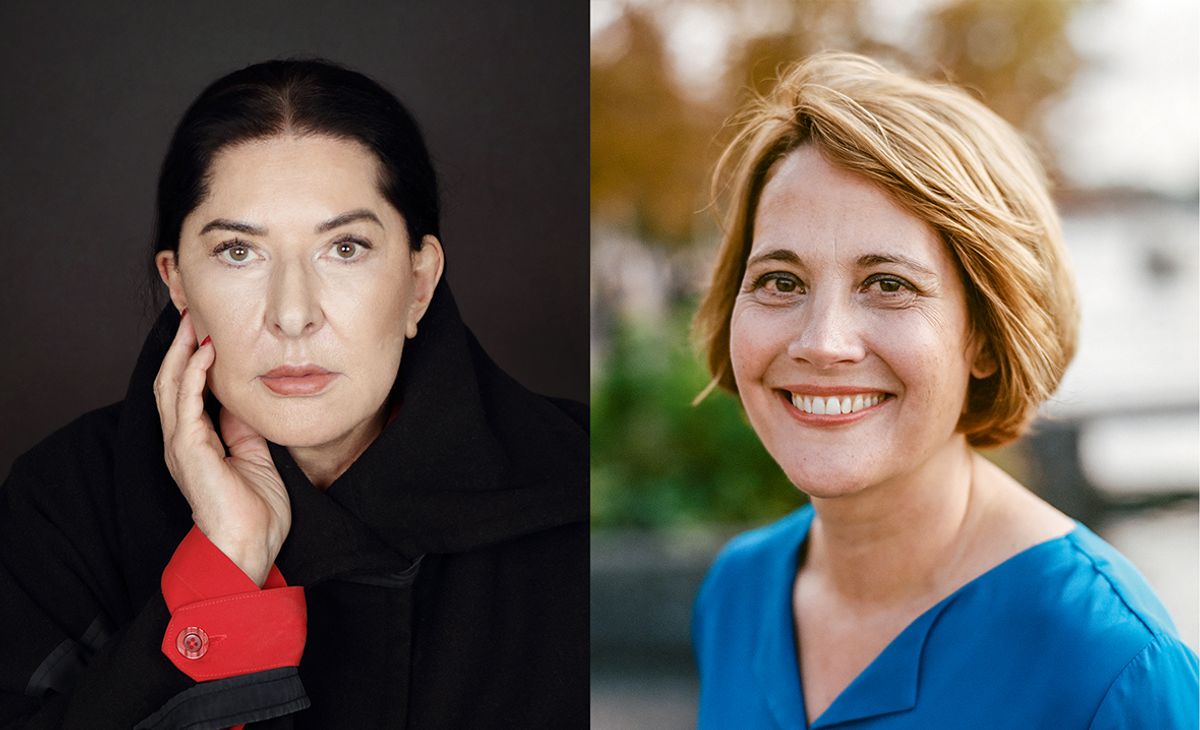
Furthermore, the godmother of performance art, Marina Abramović,unveiled a new work on Monday entitled THE BUS at Davos this year, marking her debut at the forum. This piece, which invites participants to step away from the forum schedule and the demands of modern life, may prove challenging. “However, as Abramović reminds us, reflection is ‘not the opposite of progress but its prerequisite’, making her work a meaningful intervention in the high-intensity environment of the World Economic Forum,” Fowler says. We asked Abramović and the project curator Mirjam Varadinis, also a curator-at-large at the Kunsthaus Zürich, about the motivations behind the meditative work and why Davos is the perfect launchpad for the piece.
The Art Newspaper: How did the Davos project come about?
Mirjam Varadinis: We’ve both been interested in the power of art beyond museum walls for a long time. I’ve curated many projects outside of traditional institutions, and Marina founded her institute [the Marina Abramović Institute, MAI] almost 20 years ago, which has created many “nomadic” projects. In 2024 we came together for Marina’s retrospective at the Kunsthaus Zürich, where our discussions on the role of art in today’s world led us to discover this common passion for formats that push the borders of how we experience art.
Marina Abramović: The idea of THE BUS was born as part of my institute. I wanted to offer an opportunity to pause and embark on an inner journey with the Abramović Method, extending it to a wider audience not just limited to the art world. THE BUS makes this possible, as it is part mobile sculpture and part meditation capsule, and can travel to different places and locations. It also links to my own biography as I lived in a small bus with my former partner Ulay for five years.
What does Davos mean to you? Is it an opportunity to find out more about pressing global issues and meet leaders and public figures?
MA: The concept of bringing people together is crucial to THE BUS. We want
to make a real impact around the globe and launching it at the World Economic Forum in Davos means global leaders can participate. It means decision makers can join together in silence, remembering or finding common ground between them. Such unity is urgently needed in the world right now, and we’re offering the WEF a brand new approach to achieving this.
MV: Both the scale and prestige of the WEF offer potential for real impact. To start the journey of THE BUS there, among decision makers from around the globe, feels incredibly powerful and relevant—as we aim to contribute to dialogue and peace in the world with this project, both on an individual and collective level.
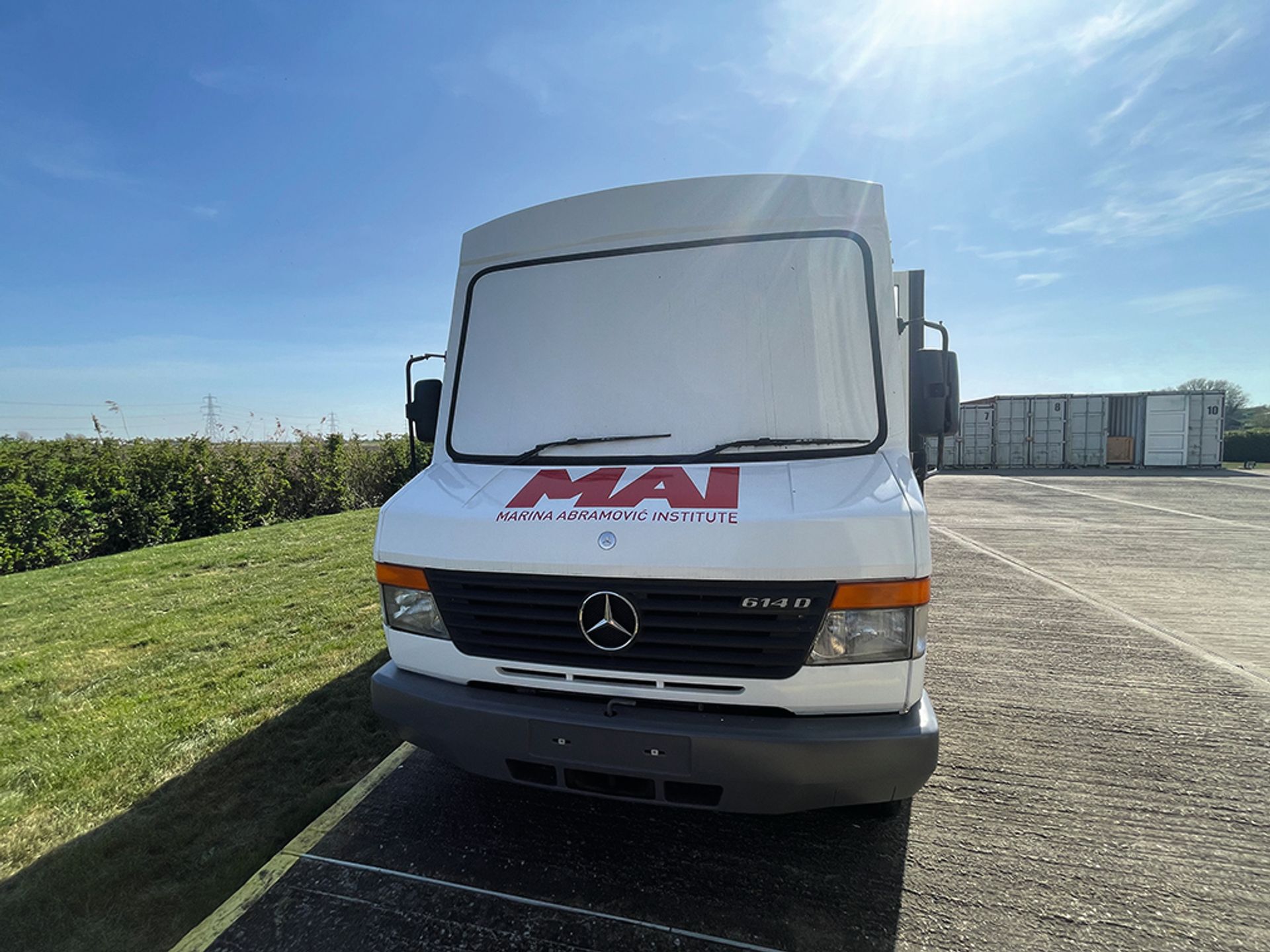
Abramović describes THE BUS as “part mobile sculpture and part meditation capsule”
Did you both devise the concept for THE BUS?
MA: Working with Mirjam at the Kunsthaus Zürich was a great experience for me. It was through that collaboration that the idea of her curating THE BUS was born.
MV: For the exhibition in Zürich, Marina conceived a new work, called Decompression Chamber. It was a space where people could pause for a moment and decompress. The effect it had on visitors was impressive and showed how important deceleration and digital detox are in an era defined by constant connectivity and digital speed. We wanted to come up with a platform that would make this experience accessible to everybody.
So THE BUS is designed to decelerate life and time?
MA: The participants of THE BUS are required to lock away their cell-phones, computers and watches when they arrive. They have to go through a short process of digital detox as part of the first experience. After this, facilitators will lead them to their seat and give them noise-cancelling headphones. Then a programme will start that will lead them through specific exercises from my Marina Abramović Method. The windows of THE BUS are closed so you can’t see or be seen from the outside. The core idea is to invite people on an inner journey for a certain amount of time to focus on the present moment, on the here and now. Even though participants at the WEF can only dedicate a small amount of time to their journey on THE BUS, it should be enough to give them a glimpse of the experience. We want to give them a moment of being entirely present—a small escape from their busy schedules in Davos, into the silence of the here and now.
Is slowing down an act of resistance? Is this even possible today?
MA: Unfortunately, technology rules our lives. But you have willpower and you can decide to do a digital detox, even if it’s only for 15 minutes. Every single human is capable of doing so. The people who come to the WEF are extremely busy and deeply engaged in their own worlds. This is why they need it the most.
MV: We live under constant pressure to perform more, better and faster. If you don’t follow that pattern, you’ll soon be left out. At least that’s what we are led to believe. It takes bravery to challenge this performance mindset. So, in that sense, I think you can define the act of slowing down and not participating in this frenetic pace as an act of resistance—and one that’s very needed in today’s world.
What will participants need to do in THE BUS?
MA: I won’t explain the experience in detail, as that would take away every surprise you’ll experience on THE BUS. Also, I think trust is very important.
I want you to trust me in taking this journey of 15 to 20 minutes without
having to know every step in advance. You cannot compare it to a conference, where you attend with an exact list of the points you’re going to discuss. This is not a conference. This is not work. This is a completely different journey into yourself to slow down.
How does empathy underpin the work?
MA: I can’t predict the feelings of the participants. I give them the opportunity to embark on a journey but I can’t predict their reactions or feelings. This is a journey they must take themselves.
MV: We live in a time dominated by conflict. Therefore we need to rebuild common ground. THE BUS creates a shared experiential space to unite people by bringing them together in silence. It is in this silence that a space opens up for mutual understanding and empathy.
Who will take part? What is the audience?
MA: I will give a speech as part of the official programme at the World Economic Forum in Davos where I will explain my Abramović Method and I will invite everyone to participate. THE BUS will be placed outside the conference centre and the WEF participants can take part by booking a time slot. It’s always 12 people who can experience it at the same time.
You’re hopeful that Davos delegates will take the time to participate and fully concentrate?
MA: This is a question that I am asking myself too. I’m making an offer—now it’s up to the participants to decide if they are open to making this journey into the unknown.
What will happen to THE BUS after Davos? Will other people be able to experience the work?
MV: We want THE BUS to have as big an impact as possible. It will continue
from Davos to Zurich in early summer, for a collaboration with the University of Zurich that showcases its potential as a tool for transformation and research in the educational field.
Each stop THE BUS makes will be individually curated, and our special focus in Zurich will be on the topic of mental health, especially among adolescents and young adults. Marina will design content tailored to teenagers and young adults, which will be accompanied by workshops. In addition to this specific focus, people of all ages are invited to join THE BUS in Zurich—it will be open to all who are interested.
MA: Our long-term plan for THE BUS is to tour through different countries in Europe, reaching people from a huge variety of backgrounds. I will create a unique encounter for each location, with the common theme of uniting people and inviting them to reflect on the world and reconnect with the present moment.
What are your future projects Marina?
MA: In addition to continuing with THE BUS, I have a long list of future projects. I am opening a big show entitled Transforming Energy, at the coming edition of the Venice Biennale [Gallerie dell’Accademia, Venice, 6 May-19 October], and in autumn another show is planned at Galleria Nazionale d’Arte Moderna e Contemporanea in Rome. I am touring my new project, Balkan Erotic Epic, around the world (Barcelona, Berlin, New York). I am going to the Kochi-Muziris Biennale in India (until 31 March) to show my video work, Waterfall. I am also producing two books: a publication about Balkan Erotic Epic and a book of stories called Long Life, Short Stories.
• For more, see www.the-bus.world