

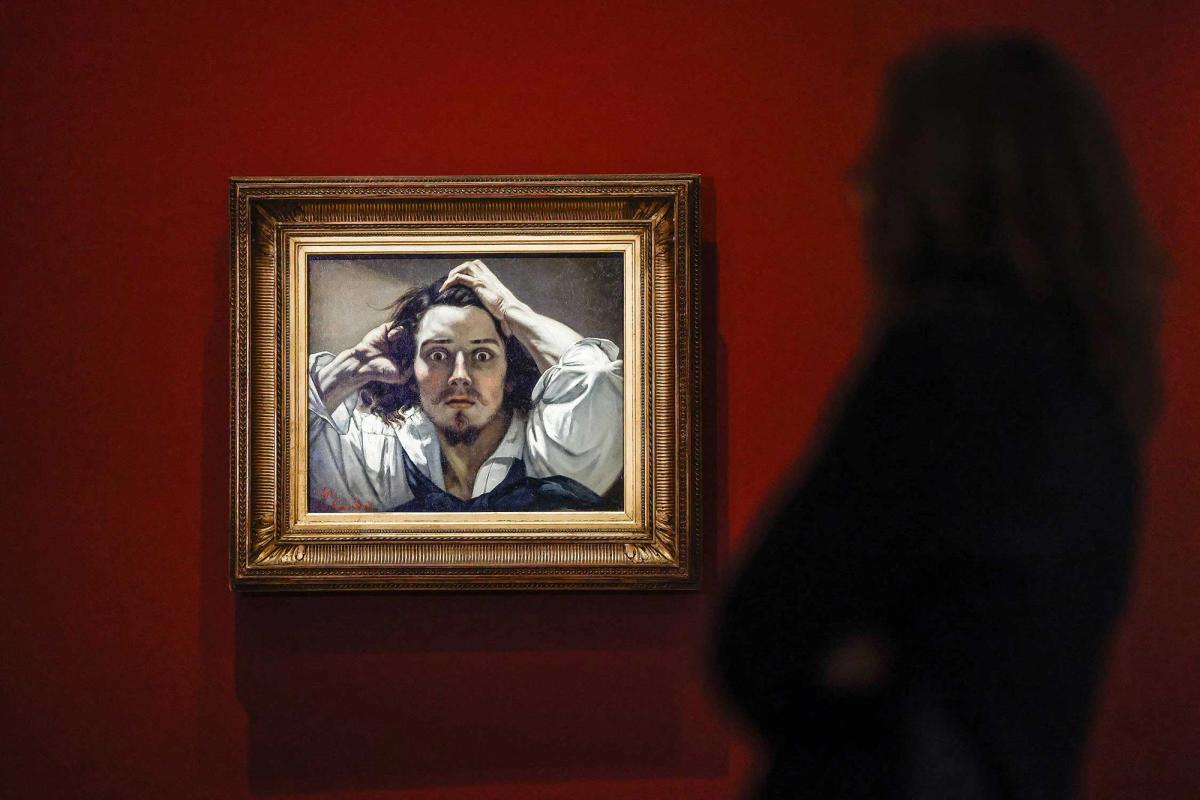
One of Gustave Courbet’s best-known early paintings, Le Désespéré (1843-45), has been acquired by Qatar Museums from a French collector without an application for an export licence, the Musée d’Orsay revealed in October at an invitation-only VIP event at the museum. The disclosure was contained in an announcement that the museum would be exhibiting the work, lent by its new owners, for a five-year term.
Courbet’s wide-eyed, tousle-haired self-portrait has not been seen in public since it was featured in the 2007-08 Courbet retrospective at the Grand Palais and the Metropolitan Museum in New York, and then at the Schirn Kunsthalle in Frankfurt in 2010-11.
According to Le Monde, Qatar Museums, the institution officially responsible for Qatar’s burgeoning cultural sector, bought the painting for €50m in 2014. Christine Martin-Veillet, a friend of the seller, Monique Cugnier-Cusenier, who died earlier this year, said that the latter “expected that the painting would remain in France”. Le Monde also reported that the new owners only told the French government of their acquisition in 2024, a decade after they had bought it.
Long-term loan to Musée d’Orsay
The news was announced at an event at the Musée d’Orsay celebrating the life of its president, Sylvain Amic, who died in August this year. The guests included high-level representatives from France and Qatar, including Sheikha Al Mayassa bint Hamad bin Khalifa Al Thani, the chair of Qatar Museums and the sister of the Emir of Qatar, and Brigitte Macron, the wife of the French president.
A spokesperson for Qatar Museums confirmed the loan agreement. “It is a long-term loan to the Musée d’Orsay until the opening of the Art Mill Museum in Doha—2030 at the earliest. The painting will then be exhibited for a period of time in this museum under a temporary export authorisation for exhibition purposes, then rotated between Paris and Doha under the same rules of authorisation.”
Under normal procedures, the purchase of a work of such national cultural importance—with a value of more than €300,000—by a foreign buyer is followed by an application for an export licence under the rules of the French cultural heritage code. The French state would then have four months in which to match the price paid by the foreign buyer. On this occasion, no export certificate was applied for on the basis that Qatar Museums would keep the work in France and show it in Qatar for limited periods using a temporary export licence, which is granted typically for the loan of national treasures for exhibitions abroad.
Julien Lacaze, the president of the French cultural heritage organisation Sites and Monuments, tells The Art Newspaper that the absence of an export certificate has raised questions among some French cultural heritage campaigners. “The exemption from the requirement for an export certificate, which is granted for ‘participation in an exhibition’, does not apply here,” he claims. “The exemption is only supposed to be a one-off event for a limited period, and not for a recurring exhibition, 50% of the time, and in the same museum.”
The deal was signed against the backdrop of multi-billion-dollar agreements between France and Qatar for museum collaborations and consultancy, defence cooperation, the purchase of Qatari liquefied natural gas by France, and a reported $10bn investment by Qatar in sectors of the French economy. A Musée d’Orsay statement described the transaction as “an exceptional agreement” whereby “after an initial period of presentation at the Art Mill Museum, the painting will be exhibited alternately between Paris and Doha”.
Similar arrangements
In recent years similar sharing arrangements for important works of art have avoided the need for export certificates. Pierre Valentin, an art lawyer from the firm Fieldfisher, says he is familiar with situations in the UK similar to the Courbet deal that allowed foreign collectors to keep a work of art in the country rather than apply for an export licence, but declined to name them for reasons of client confidentiality.
In 2015, the Musée du Louvre in Paris and the Rijksmuseum in Amsterdam jointly bought two Rembrandt portraits from the Rothschild family for €160m. The works, which are always shown together, are displayed for eight-year periods in each city. Similarly, between 2009 and 2012, the National Gallery in London and the National Galleries of Scotland in Edinburgh clubbed together to buy two Titian paintings from the Duke of Sutherland for a total of £95m. It has also been widely reported that the British Museum is in discussions with Greece about offering the Parthenon marbles on a long-term loan in another kind of arrangement to avoid the restrictions of cultural heritage protection laws, in this case the British Museum Act of 1963, which forbids the institution from disposing of items in its collection except in very limited circumstances.
Qatar previously made a sharing arrangement with London’s National Portrait Gallery (NPG) over the earliest known portrait of a freed slave—William Hoare’s Ayuba Suleiman Diallo (1733). In 2009, Qatar bought the painting at Christies for £530,000. It applied for an export licence but when the NPG managed to raise the money to match Qatar, the latter withdrew its application for export and lent the picture to the NPG instead.
The Courbet case is unusual in that it did not go through an export licence process. Neither the French ministry of culture nor the Musée d’Orsay have put a time limit on how long the temporary loan to Qatar Museums might last. “It is pushing things down the line, not addressing things now by this mechanism—it kicks the ball into the future,” Valentin says. “If it’s going there for 100 years, then yes, this is a problem, but we are not in a position to say whether this arrangement is problematic yet. At the moment, it is win-win,” he says.