

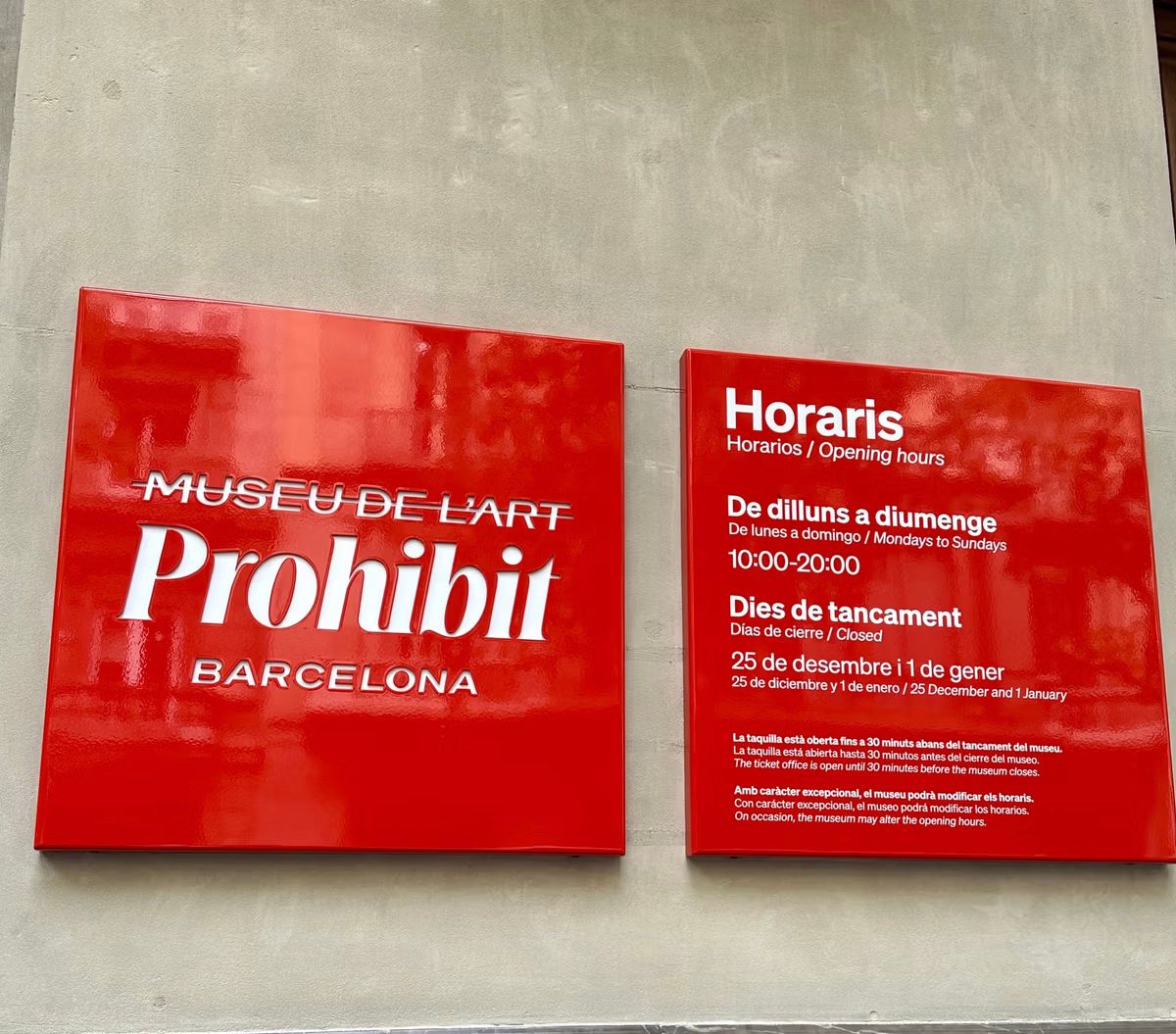
The world’s first museum of censored art, the Museu de l’Art Prohibit in Barcelona, has closed its doors indefinitely less than two years after opening. The institution, which housed banned works by artists such as Ai Weiwei, David Wojnarowicz and Abel Azcona, was launched in October 2023 by the Catalan journalist and businessman Tatxo Benet. However the museum closed in late June, blaming disruption caused by workers picketing the institution.
The Museu de l’Art Prohibit collection included more than 200 works that were “censored, prohibited or denounced due to political, social or religious reasons”, according to a previous statement. Works on show included Eugenio Merino’s controversial Forever Franco (2012)—a sculpture of the former Spanish dictator Francisco Franco standing in a fridge—and Ines Doujak’s installation Not Dressed for Conquering - HC04 Transport (2010), which shows a former Spanish king engaged in a sex act with a dog.
An online statement, posted by the museum on 27 June, says: “It is a painful and undesired closure, but an unavoidable one, due to the financial losses caused by the protest staged outside the museum for the past four months, led by the Solidarity and Unity of Workers union (SUT). During this period, the threats and slander resulting from this situation have disrupted the museum’s normal operation, and the losses have become unsustainable.”
According to the Catalan newspaper Ara, the protest was sparked by the museum's termination of a contract with the management company Magma Cultura, which employed seven workers at the venue. Union members subsequently demanded an improvement in working conditions including better air conditioning, more breaks and increased pay.
“The museum has become a caricature… taking a contradictory stance,” alleges the union in an online statement. Benet and the SUT union were both contacted for comment.
Benet, the museum's founder, says he now plans to send the collection on a global tour. “A year and a half after its inauguration, the only museum in the world dedicated to exhibiting banned works is closing with the aim of transforming itself into a nomadic collection with traveling exhibitions around the world,” adds the museum statement.
Benet’s collection also includes Pablo Picasso’s Suite 347 (1968), which was banned by the Art Institute of Chicago in the 1960s, and Goya’s satirical series of engravings, Caprichos (The Caprices, 1797-99).