

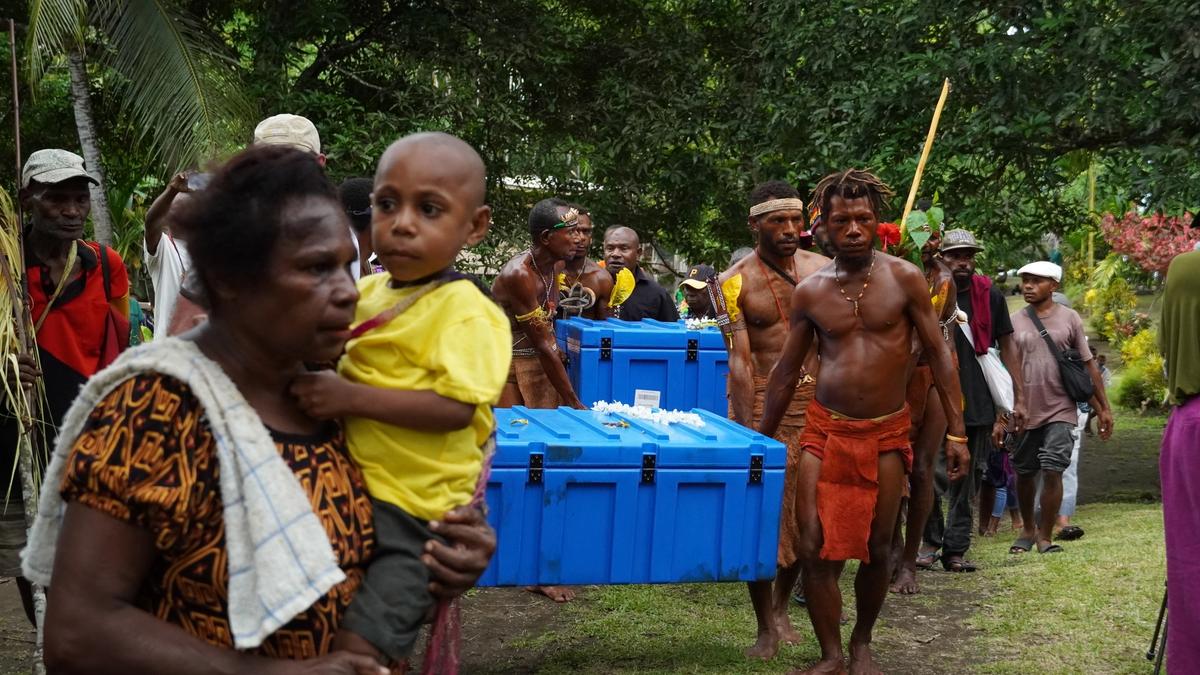
Colourful ceremonies featuring song and dance, petal-strewn pathways and the roasting of specially-selected pigs accompanied the emotional repatriation of 16 human skulls to Papua New Guinea last week.
The ancestral remains were returned to the inhabitants of six villages including Gorendu and Bilibil in Madang province, having been transported home from Sydney University’s Chau Chak Wing Museum in Australia.
Some of the crania belonged to people whose names are known and remembered in their homeland, according to the Chau Chak Wing Museum’s senior curator Jude Philp, who formally handed over the skulls to the beating of drums and the handing out of leis (necklaces made of flowers).
“People are looking at [the repatriation] as a rebirth of their history, in some ways, and to think about those people and the wisdom of that time,” Philp told The Art Newspaper.
At coastal Bilibil, Philp and other dignitaries arrived at the ceremony in boats and brought the craniums ashore in special boxes.
“As we got to the beach, four young men dressed as warriors came to us with spears and bows and arrows and shouting,” she said. Once ashore, dignitaries’ faces were rubbed with scented ochre, “recognising it’s all about grief and mourning”.
The 16 skulls were taken from Papua New Guinea’s Rai Coast in 1876-77, having been collected by Russian scientist Nickolai N. Miklouho-Maclay during an expedition. In his journal, Miklouho-Maclay wrote that the skulls were freely given and were not exhumed remains.
Jack Simbou, a deputy secretary at Papua New Guinea’s Department for Community Development and Religion, said welcoming ancestors was a moving experience for the community.
“These ancestors were taken by Nickolai almost 150 years ago, to support his work promoting one shared humanity,” Simbou said. “They departed the Rai Coast aboard a Russian Corvette and returned on a Boeing jet. Their journey spans time and distance and we extend gratitude to the Chau Chak Wing Museum for reuniting us."
Miklouho-Maclay arrived in Sydney in 1878 and began working with William John Macleay, a fellow natural history enthusiast whose philanthropy enabled the creation of Sydney University’s Macleay Museum in 1887. In 1888 the crania were donated to the Macleay Museum by Miklouho-Maclay’s widow. That museum became part of the Chau Chak Wing Museum in 2020.
The Chau Chak Wing Museum received gifts of thanks from Papua New Guinea, including a “glorious pot” from Bilibil where pot-making is renowned, Philp said.